


Strong Foundations for Lasting Structures
Every successful building project begins beneath the surface. At GEO Builder, we understand that solid foundations are the backbone of any construction endeavor. Whether you are planning a multi-story residential complex, a commercial office tower, or an industrial facility in Bangladesh, the quality of your pile foundation directly determines the longevity and safety of your structure.
Piling represents one of the most critical components of modern construction engineering. It serves as the deep foundation system that transfers heavy loads from your building down to stable soil or rock layers below. Bangladesh presents unique geotechnical challenges due to its alluvial soils, river plains, and varying soil composition across different regions. This is precisely why choosing an experienced partner like GEO Builder for your piling requirements becomes essential.
সহজ পাইল কস্ট ক্যালকুলেটর
জটিল হিসাব ছাড়াই আপনার পাইলিংয়ের বাজেট জেনে নিন। (বর্তমান বাজারদর)
পাইলের মাপ ও সংখ্যা
বর্তমান বাজার দর
মালামাল ও খরচের সারসংক্ষেপ
* এটি শুধু মালামালের বেসিক হিসাব। লেবার ও বোরিং চার্জ যুক্ত নয়।
Our team of qualified engineers and skilled technicians has delivered countless successful piling projects across the country. We combine cutting-edge technology with time-tested methodologies to ensure your foundation is built to last. From initial site assessment to final installation, we maintain rigorous quality control standards and adhere to international building codes.
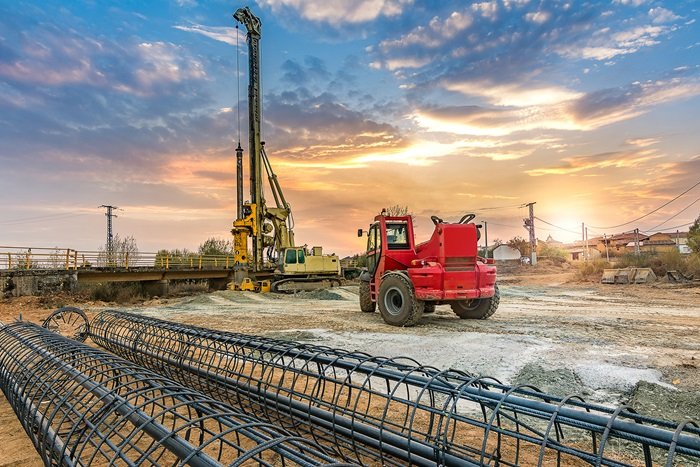
Understanding the Fundamentals: What is Piling?
At its core, piling is a deep foundation technique used to transfer the structural load of a building or a heavy infrastructure project to deeper, stronger, and more stable soil or rock layers, bypassing the weaker surface soil. Imagine trying to build a heavy bookshelf on a thick carpet; it would wobble and sink under the weight. But if you place its legs on the solid floor underneath the carpet, it stands firm and secure.
Piling works on a similar principle. These deep foundations, known as piles, are long, slender columns typically made of materials like reinforced concrete, steel, or timber. They are driven, drilled, or jacked into the ground to a depth where they can adequately support the load through two primary mechanisms: end-bearing and skin friction. An end-bearing pile functions like a column, transferring the load directly onto a firm layer such as bedrock or dense sand. A friction pile, on the other hand, transfers the load to the surrounding soil through the frictional resistance developed along its surface area. Often, a pile will utilize a combination of both end-bearing and friction to achieve the required load-bearing capacity. The choice between these, and indeed the entire piling strategy, is a decision rooted in comprehensive soil analysis and precise engineering calculations. For a country like Bangladesh, with its predominantly soft alluvial plains, piling is not just an option; it is often an absolute necessity for ensuring foundation stability and preventing structural failure.
When is Piling a Construction Necessity?
The decision to implement a pile foundation is a critical one, driven by a combination of site-specific factors and project requirements. It is a solution reserved for situations where conventional shallow foundations, like strip footings or pad footings, would be inadequate or unsafe. Understanding these scenarios is key to appreciating the vital role piling plays in modern construction across Bangladesh.
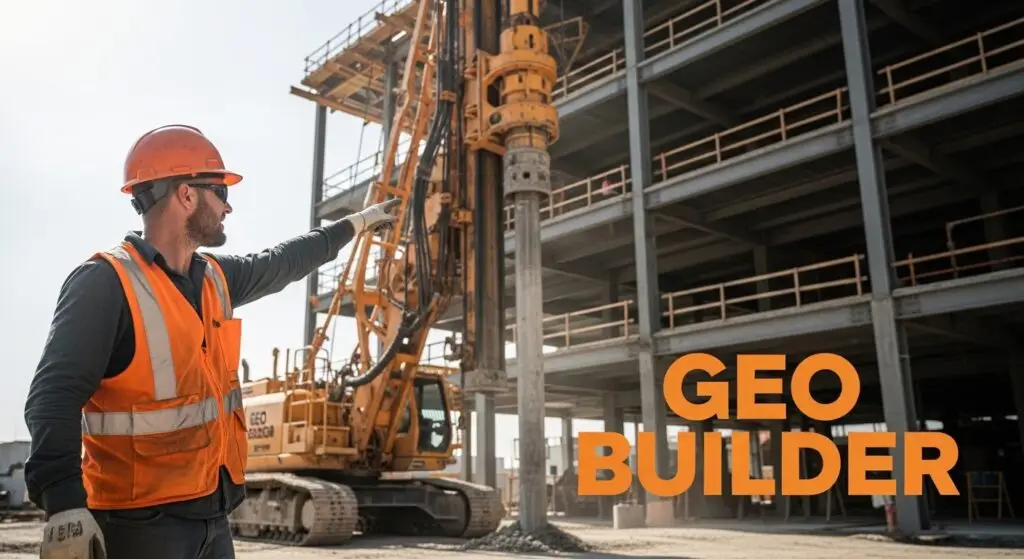
- Weak Surface Soil: The most common reason for opting for piling is the presence of weak, compressible, or unstable soil near the surface. The vast deltaic regions of Bangladesh are characterized by such soils, which have a low soil bearing capacity and would settle excessively under the weight of a structure, leading to cracks and potential collapse. Piles bypass this weak layer to anchor the structure in competent strata below.
- High Load-Bearing Capacity Requirements: As we build taller and more complex structures, the loads they impose on the ground increase exponentially. Multi-story buildings, heavy industrial facilities with large machinery, and massive infrastructure projects like bridges and overpasses generate immense concentrated loads. Shallow foundations simply cannot distribute these loads effectively. A piling system is designed to handle this immense load-bearing capacity, safely transferring the forces deep into the ground.
- Uplift and Lateral Loads: Structures are not just subjected to downward gravitational forces. Tall, slender buildings are vulnerable to horizontal wind forces, and structures in areas prone to seismic activity face lateral loads from earthquakes. Piles, especially when used in groups and connected by a sturdy pile cap, provide excellent resistance against these uplift and lateral forces, anchoring the structure firmly to the ground.
- Soil Erosion and Scouring: For structures built near rivers, such as bridges, pumping stations, or riverfront buildings, the foundation is at risk from scouring. Scouring is the erosion of soil around the foundation due to fast-flowing water, which can undermine the support of a shallow foundation. Piles are driven deep enough to remain unaffected by surface erosion, ensuring the long-term foundation stability of the structure even during major floods.
- Expansive or Collapsible Soils: Certain types of soils, like clay, expand significantly when wet and shrink when dry. This cyclical movement can wreak havoc on a shallow foundation. Other soils may collapse upon wetting. By driving piles through these unstable layers and anchoring them in stable ground below, we isolate the structure from the damaging effects of these problematic soils.
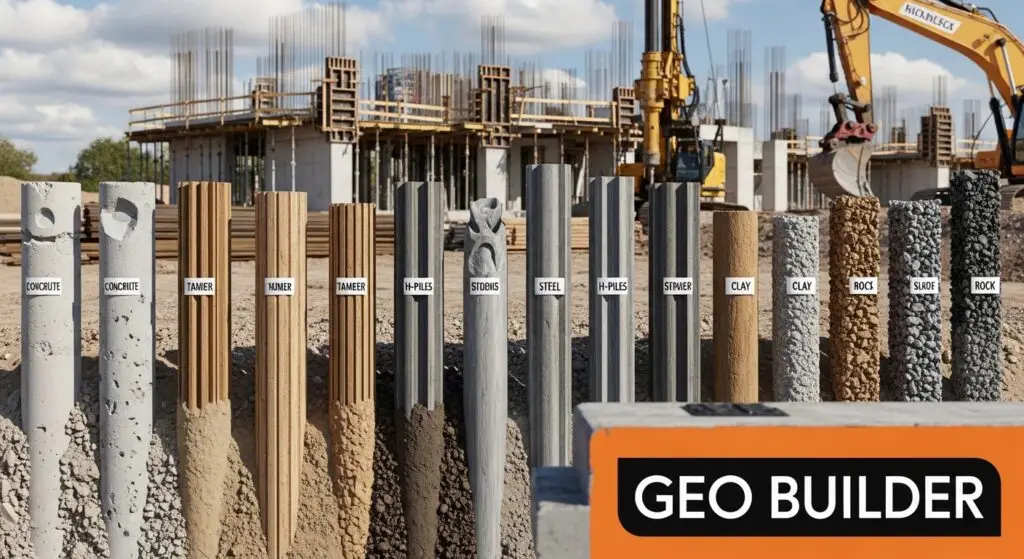
Types of Piles: Choosing the Right Solution
Modern construction offers several pile varieties, each suited to different soil conditions and project requirements. Understanding these options helps you grasp why GEO Builder recommends specific solutions for your project.
Concrete piles are the most widely used type of piling in Bangladesh, prized for their versatility, high compressive strength, and cost-effectiveness. They can be broadly divided into two categories:
- Cast-in-Situ Concrete Piles: These piles are constructed by first drilling a borehole into the ground to the required depth. A steel reinforcement cage is then lowered into the hole, which is subsequently filled with concrete. The concrete hardens in place, forming a solid, integral pile. The advantage of this method is its adaptability; the length of the pile can be adjusted on-site based on the actual soil conditions encountered. Common methods for creating cast-in-situ piles include the Continuous Flight Auger (CFA) method and the bore-and-pour method using temporary or permanent casings to prevent the borehole from collapsing, especially in the water-logged soils common in Bangladesh.
- Precast Concrete Piles: These piles are manufactured in a controlled factory environment, transported to the site, and then driven into the ground using pile hammers. They offer superior quality control as the concrete is cured under ideal conditions. However, their handling and transportation require care to prevent cracking, and their length is fixed, which can be a limitation if unexpected subsoil conditions are met during driving. They are ideal for projects where speed of installation is a priority and the ground conditions are well-understood.
Steel Piles: Strength and Penetration Power
Steel piles are renowned for their exceptional strength-to-weight ratio and their ability to be driven through very dense or hard soil layers, even reaching bedrock.
They are typically used for projects requiring extremely high load-bearing capacity or for deep foundations in marine environments.
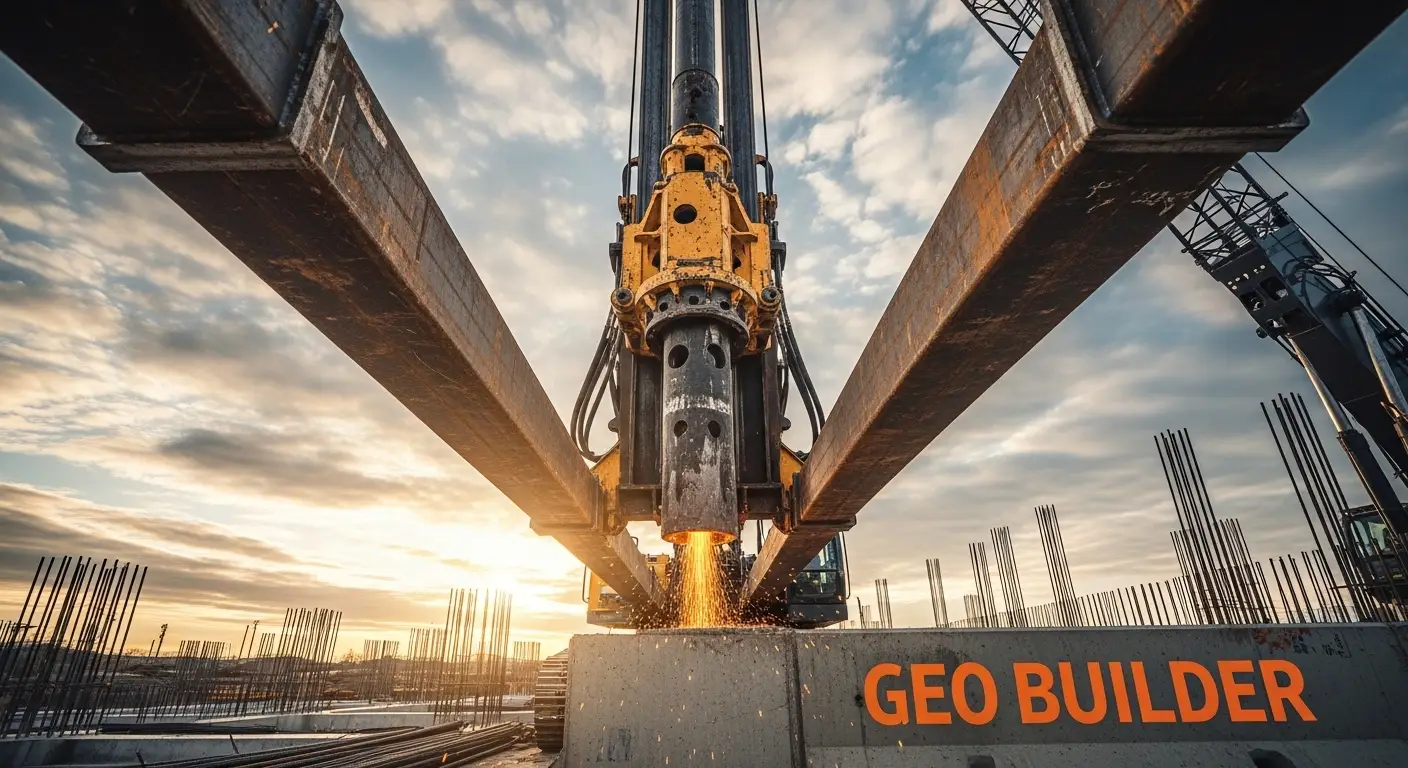
H-Piles: These are structural steel beams shaped like the letter ‘H’. Their flanges and web provide high structural strength and make them efficient at bearing load. They are particularly effective in end-bearing applications where they need to penetrate through dense layers to reach a firm stratum.
Pipe Piles: These are hollow steel pipes that can be driven with an open or closed end. After driving to the desired depth, an open-end pipe is often cleaned out and filled with concrete. This creates a composite pile that combines the structural strength of the steel shell with the compressive strength of the concrete core, making it incredibly robust.
While steel piles offer superior strength and ease of installation, their primary disadvantage in the Bangladeshi context is their susceptibility to corrosion, especially in aggressive, high-water-table soils. This necessitates proper protective coatings or increased thickness, which can add to the cost.
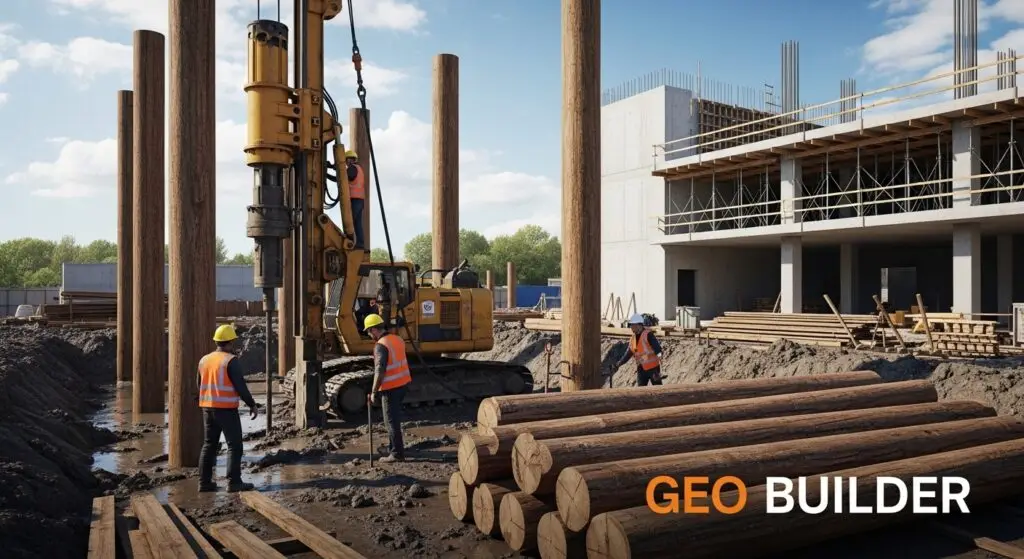
Timber Piles: A Traditional Solution with Limited Modern Use
Timber piles have been used for centuries and are still occasionally employed for specific applications. They are typically treated with preservatives to protect against rot and insect attack. Their main advantages are low cost and ease of handling. However, their use is limited to lighter structures and temporary works. They cannot be driven through hard soil, are vulnerable to damage from hard driving, and have a limited lifespan compared to concrete or steel piles.
In modern Bangladeshi construction, their use is rare, mostly confined to temporary support structures or in very specific rural or coastal projects where other materials might not be readily available. However, timber piles require careful selection and preservation. Exposure to air and moisture fluctuations accelerates decay. Therefore, GEO Builder recommends timber piles primarily for permanently submerged applications or when environmental considerations favor this renewable resource.
Comparison of Pile Materials
|
Feature |
Concrete Piles (Cast-in-Situ/Precast) |
Steel Piles |
Timber Piles |
|
Load-Bearing Capacity |
High (Compressive) |
Very High (Compressive & Tensile) |
Low to Moderate |
|
Durability |
Excellent |
Good (requires corrosion protection) |
Fair (requires treatment) |
|
Cost |
Moderate |
High |
Low |
|
Installation |
Can be noisy (driving) or complex (boring) |
Relatively fast and easy driving |
Easy driving, but limited depth |
|
Suitability for Bangladesh |
Highly Suitable for most projects |
Suitable for heavy structures & marine works |
Limited to temporary or light structures |
|
Common Use Case |
Multi-story buildings, industrial plants |
Bridges, high-rise structures, deep foundations |
Temporary works, coastal protection |
Pile Installation Methods: Technology Meets Precision
The method you select for pile installation significantly impacts project timeline, cost, and final quality. GEO Builder employs various advanced techniques, selecting the most appropriate approach based on your site conditions, environmental considerations, and project specifications.
Pile Driving Method: Proven and Powerful
The pile driving method represents the most straightforward and widely used installation technique. Heavy hammers or drop mechanisms strike the pile head, driving it progressively deeper into the ground through successive impacts. The drop hammer method involves releasing a weighted hammer from heights of several meters, allowing gravity to drive the pile downward. This traditional approach works efficiently for many soil conditions and remains cost-effective for numerous projects.
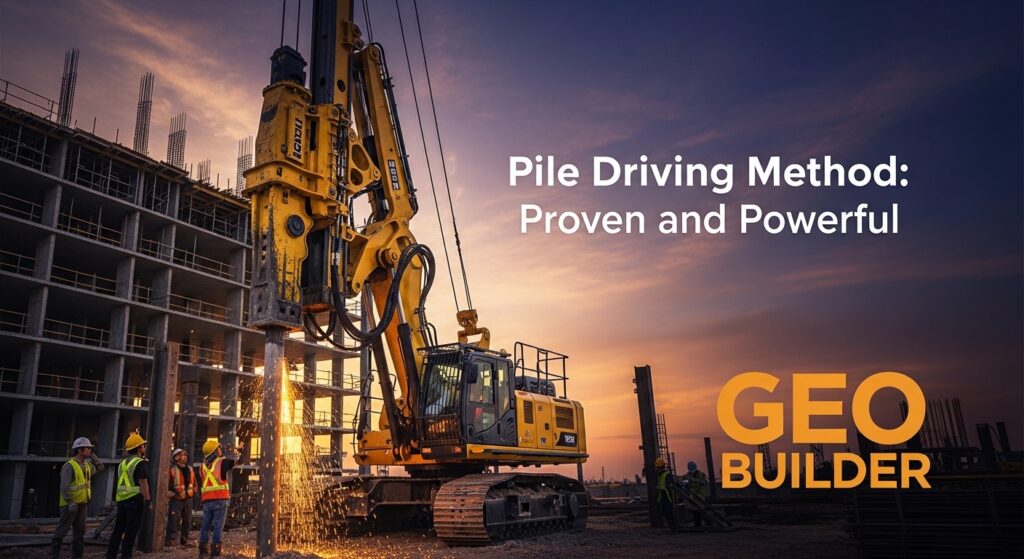
The hydraulic pressing method employs powered hydraulic systems to push piles into the ground using constant pressure rather than impact force. This technique reduces vibration and noise, making it superior for congested urban areas or projects near sensitive structures. The controlled pressure application prevents pile damage and provides superior control over final depths.
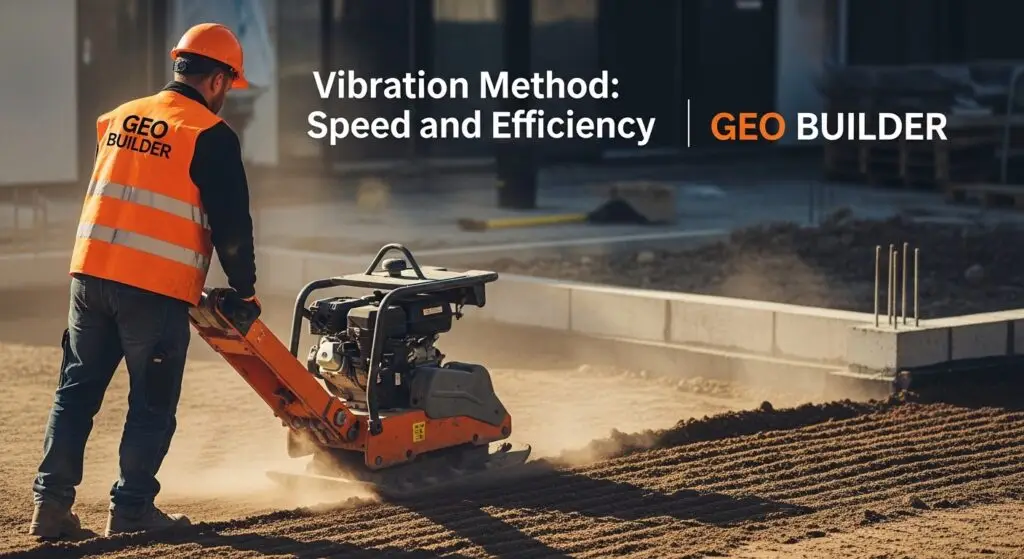
Vibration Method: Speed and Efficiency
Vibration piling utilizes high-frequency mechanical vibrations to reduce soil friction and allow piles to penetrate more easily. Specialized equipment vibrates the pile while workers apply downward pressure, reducing the resistance encountered during installation. This method excels in sandy or granular soils where vibration particularly reduces skin friction. Projects on tight timelines benefit significantly from the vibration method’s efficiency. The technique produces minimal noise compared to pile driving, though vibration levels require monitoring in sensitive areas.
Jetting Method: Fluid-Assisted Installation
Jetting involves directing pressurized water jets against the soil around the pile shaft, temporarily reducing soil strength and facilitating easier penetration. Water pressure essentially liquefies soil particles, creating minimal friction against the pile. This method performs exceptionally well in dense sandy soils or silty conditions. The jetting process accelerates installation and minimizes pile damage, proving particularly valuable for sensitive pile types. However, jetting requires adequate drainage and consideration of ground water impacts.
Screw Piling Method: Modern Innovation
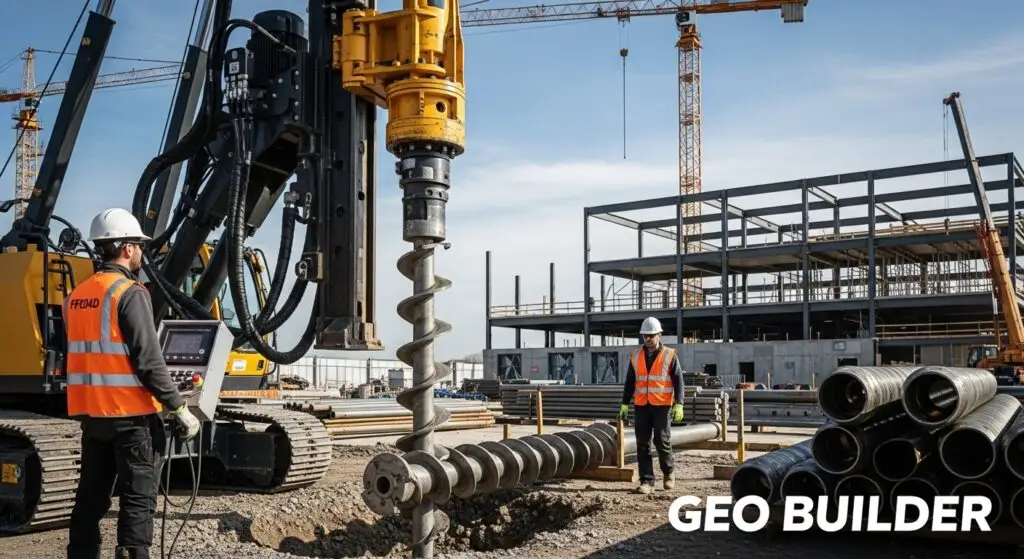
Helical or screw piles feature large threads that bite into soil as they rotate, similar to a screw entering wood. Specialized rotating equipment turns these piles into the ground, making them particularly suitable for difficult access sites or areas where vibration restrictions apply.
Screw piles offer excellent performance in mixed soil conditions and require minimal preliminary boring. They work efficiently in sensitive areas and deliver consistent performance across varying soil types. Many modern construction projects in Bangladesh increasingly select screw piling for these advantages.
The Piling Process: From Assessment to Completion
Understanding the piling process helps you appreciate the expertise GEO Builder brings to every project. Our systematic approach ensures nothing is left to chance.
Geotechnical Investigation and Soil Analysis
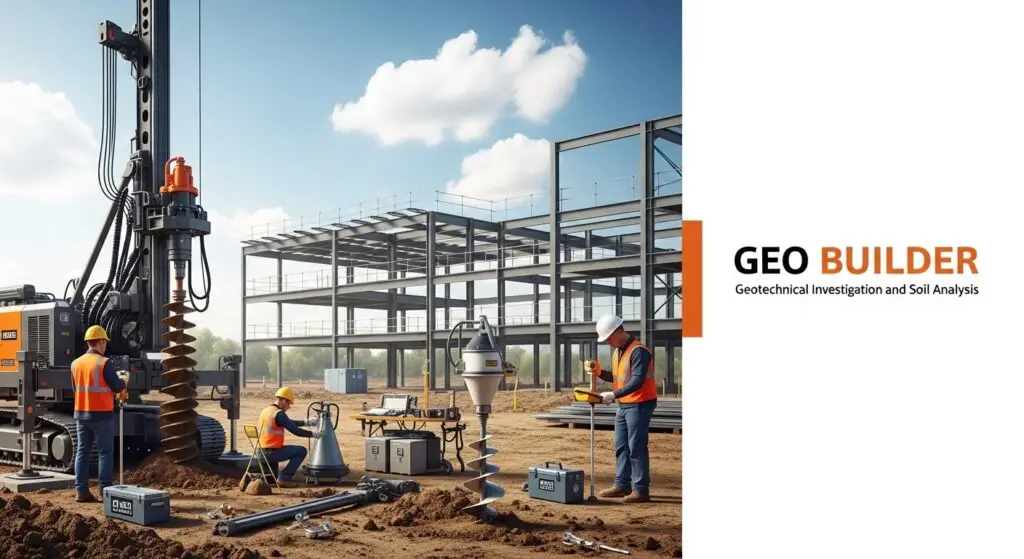
Before any pile is driven, we conduct comprehensive soil testing and subsurface investigations. Boring holes at multiple locations reveal soil composition, identify groundwater levels, and determine bearing capacity at various depths. Laboratory testing of soil samples provides essential data about soil properties, density, and load-bearing characteristics.
This investigative phase determines optimal pile depth, identifies potential obstacles, and reveals any environmental factors affecting installation. Many construction failures result from skipping this critical phase or working with incomplete site data. GEO Builder never compromises on this foundation (literally) of good engineering.
Pile Design and Specification
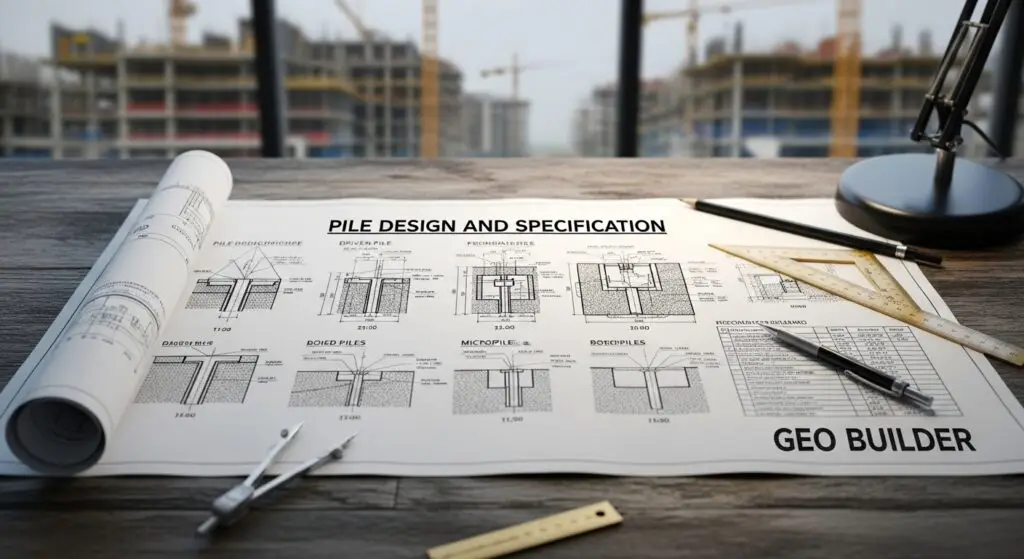
Based on soil investigation results and structural load requirements, our engineers design the pile system. Calculations determine optimal pile diameter, length, material type, and spacing. Computer modeling predicts how piles will perform under expected loads, including variations from different usage scenarios.
We ensure pile designs accommodate Bangladesh’s specific conditions: monsoon-related flooding, seismic considerations in certain regions, and the unique challenges of alluvial soils. Design specifications also incorporate proper factors of safety, ensuring structures perform reliably throughout their intended service life.
Site Preparation and Mobilization
Professional piling begins with proper site preparation. GEO Builder establishes work areas, positions equipment, and organizes logistics for efficient operations. Temporary infrastructure ensures worker safety and prevents environmental impacts. We coordinate with local authorities to address traffic management, noise considerations, and community impact mitigation. Proper mobilization prevents delays and ensures crews can work efficiently and safely throughout the installation process.
Pile Installation and Quality Monitoring
During actual piling work, continuous monitoring ensures everything proceeds according to specifications. Our engineers track pile depth, penetration rates, and installation conditions in real-time. Any anomalies are addressed immediately, ensuring quality remains consistent. We maintain detailed records of every pile, documenting installation parameters that become valuable references for future inspections or modifications. Quality control is not an afterthought but an integral component integrated throughout the installation process.
Load Testing and Verification
Following installation, load testing confirms that installed piles perform as designed. Testing loads increase progressively, with measurements documenting how the pile responds. Results are compared against design predictions, ensuring the pile foundation supports intended loads safely. This verification step provides ultimate confidence in your structure’s foundation. Results become part of your permanent project documentation, valuable for building operations, future modifications, or insurance and regulatory compliance.
Pile Foundations vs. Other Deep Foundation Solutions
Several deep foundation techniques exist beyond traditional piling. Understanding how piling compares to alternatives clarifies why it remains the preferred choice for many Bangladesh projects.
Caissons and Shaft Foundations
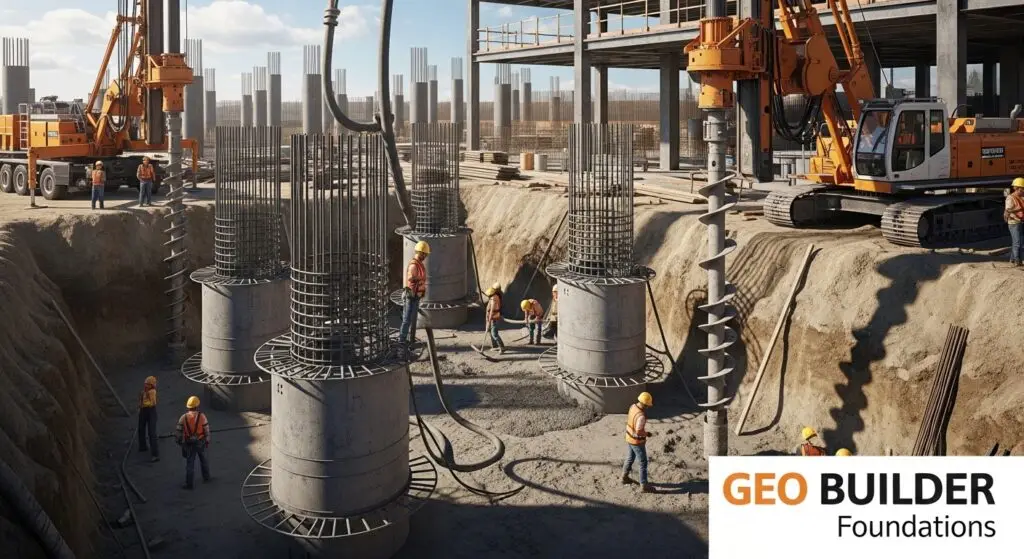
Caissons are large-diameter excavations filled with concrete, functioning similarly to massive piles. They accommodate substantial loads and work efficiently when diameters can be large enough for worker access. However, they require deeper excavation and prove more expensive for most projects.
GEO Builder considers caissons when projects require extremely deep foundations or when site conditions make traditional piling impractical. For most Bangladesh construction, however, properly designed piling offers superior economics without sacrificing performance.
Diaphragm Walls
Diaphragm walls create structural retaining elements while simultaneously serving as foundation elements. They excel in congested urban environments where space limitations restrict traditional piling. However, they demand specialized equipment and expertise, making them suitable only for specific project types.
Pile Caps and Load Distribution
Regardless of pile type or installation method, pile caps distribute building loads across multiple piles. These reinforced concrete platforms connect structural columns to underlying piles, ensuring load distribution follows engineering design. Proper pile cap design and construction prevent concentrated loads from damaging individual piles.
Advantages of Professional Piling Solutions
Investing in proper piling solutions through GEO Builder delivers multiple benefits that extend throughout your building’s operational life.
Enhanced Structural Stability
Piling reaches stable soil or rock layers, providing unwavering support regardless of surface conditions. Buildings on proper pile foundations resist settling, differential movement, and foundation failure. Occupants experience no cracking, doors that stick, or other problems associated with inadequate foundations.
Extended Building Lifespan
A strong foundation essentially guarantees your building will endure. Without foundation problems, structures typically operate reliably for their intended service life and beyond. Maintenance focuses on normal wear rather than addressing foundation issues.
Adaptation to Challenging Terrain
Bangladesh includes areas with soft soils, flood-prone regions, and locations with varying geological conditions. Piling accommodates all these challenges, enabling construction where shallow foundations would fail. Projects become feasible in locations that would otherwise be unbuildable.
Load-Bearing Flexibility
Pile systems accommodate diverse building configurations and load requirements. Whether you are building a small residential structure or a towering commercial complex, piling adapts to your needs. Modifications or additions to existing structures often integrate smoothly with existing pile foundations.
Environmental Adaptability
Bangladesh’s climate presents specific challenges: flooding, seasonal moisture variations, and potential seismic activity in certain regions. Properly designed pile foundations address all these environmental factors, ensuring reliability across decades.
The Best Piling Company in Bangladesh: GEO Builder
When it comes to securing the foundation of your most important construction projects in Bangladesh, choosing the right partner is crucial. GEO Builder stands as the leading piling company in Bangladesh, renowned for our unwavering commitment to quality, precision, and long-lasting stability. With extensive experience across diverse geological conditions unique to the region, our expert team utilizes advanced engineering techniques and state-of-the-art equipment to deliver robust and reliable pile foundations for everything from multi-story residential buildings to complex industrial structures. We pride ourselves on our meticulous approach, ensuring every deep foundation is engineered to perfection, providing unparalleled foundation stability and peace of mind for our clients. Trust GEO Builder to be your dependable choice for the strongest start to your next project.
GEO Builder’s Piling Expertise Across Bangladesh
GEO Builder has successfully completed piling projects across diverse geographical regions and geological conditions throughout Bangladesh. Our experience spans multiple project types and scales.
Residential Complex Development
Multi-story apartment buildings and residential complexes require reliable foundations supporting hundreds or thousands of residents. We have engineered and installed pile foundations for residential projects featuring dozens of stories, each properly designed and installed to exacting standards.
Commercial Tower Construction
Office buildings, shopping centers, and commercial facilities demand strong foundations capable of supporting significant floor loads. Our commercial projects showcase how professional piling enables ambitious architectural designs while maintaining absolute safety.
Industrial Facility Installation
Manufacturing plants, warehouses, and industrial structures often concentrate heavy machinery loads in specific areas. Custom pile layouts and specifications accommodate these complex load patterns, ensuring equipment operates safely and reliably.
Infrastructure Projects
Beyond building construction, GEO Builder has completed piling work for bridges, elevated structures, and infrastructure development. These projects demonstrate our technical depth and ability to solve complex engineering challenges.
Why Choose GEO Builder for Your Piling Project in Bangladesh?
Selecting the right partner for your piling needs is one of the most critical decisions you will make for your project. Here is why GEO Builder is the preferred choice for leading developers and industrialists in Bangladesh:
- Unparalleled Local Expertise: We do not just apply generic engineering principles. We have a deep, intrinsic understanding of the diverse and challenging soil conditions across Bangladesh. This local knowledge allows us to design and execute the most efficient and effective piling solutions for any site.
- A Team of Seasoned Professionals: Our team at GEO Builder comprises highly qualified geotechnical and structural engineers, veteran project managers, and skilled operators who bring decades of collective experience in piling work. Their expertise is our greatest asset.
- State-of-the-Art Equipment: We invest in the latest piling technology and equipment, from low-vibration hydraulic presses to advanced testing apparatus. This ensures we can tackle any project, regardless of its complexity or location, with precision and efficiency.
- Unwavering Commitment to Safety and Quality: We adhere to the strictest international safety standards on all our sites. Our quality assurance processes are embedded in every stage of the project, from initial soil testing to final pile testing, guaranteeing a foundation of uncompromising quality.
- A Proven Track Record: Our portfolio of successfully completed projects, including landmark buildings, critical infrastructure, and large industrial facilities, stands as a testament to our capability and reliability. GEO Builder builds foundations that inspire confidence.
Service Comparison: Piling Solutions at a Glance
|
Aspect |
Concrete Piles |
Steel Piles |
Timber Piles |
Screw Piles |
|
Load-Bearing Capacity |
High |
Very High |
Moderate |
High |
|
Installation Speed |
Moderate |
Moderate |
Fast |
Fast |
|
Cost-Effectiveness |
Excellent |
Good |
Good |
Moderate |
|
Durability |
Excellent |
Good (with coating) |
Good (submerged) |
Excellent |
|
Soil Suitability |
Most conditions |
Dense/difficult soil |
Sandy/silt |
Most conditions |
|
Environmental Impact |
Minimal |
Minimal |
Renewable |
Minimal |
|
Maintenance Requirements |
Low |
Moderate |
Moderate |
Low |
|
Bangladesh Applicability |
Excellent |
Good |
Limited |
Excellent |
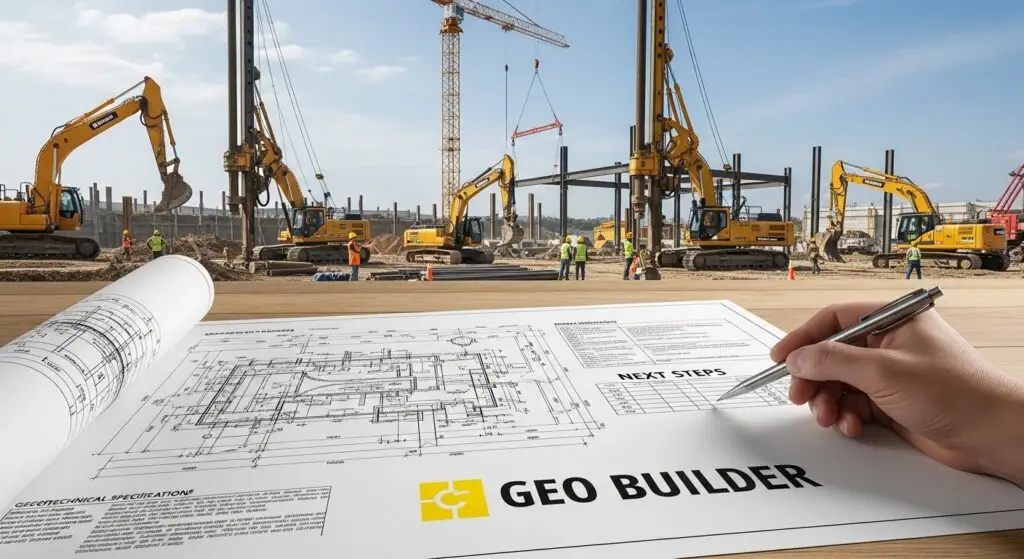
Planning Your Piling Project: Next Steps
If your construction project requires piling, beginning with a consultation establishes the foundation for success. GEO Builder conducts no-obligation preliminary discussions where we learn about your project and you learn about our capabilities.
During initial consultation, share details about your building plans, site location, and project timeline. We ask questions about site conditions you have observed and any construction history in the area. This dialogue establishes mutual understanding and allows us to provide preliminary guidance.
Following consultation, we typically recommend geotechnical investigation if you have not already conducted one. This investigation reveals essential information determining pile requirements, timelines, and costs. We coordinate this investigation efficiently, providing results within reasonable timeframes that support your project scheduling.
Once investigation results are available, we prepare detailed piling proposals including specifications, methods, equipment, timeline, and costs. These proposals reflect actual site conditions and project requirements, giving you confidence that budget and schedule are realistic.
Building Trust Through Transparency and Results
GEO Builder understands that construction represents significant financial and emotional investment for clients. We approach every project with complete transparency about what we will do, when we will do it, and what results to expect.
We maintain regular communication throughout piling work, updating you on progress, addressing any concerns immediately, and ensuring no surprises emerge. Our site supervisors welcome questions and involve project stakeholders in key decisions.
Foundation Excellence for Your Bangladesh Construction Project
Piling transforms impossible building sites into viable construction locations. Through advanced soil investigation, intelligent design, and professional installation, GEO Builder creates foundations that support your vision and ensure long-term building performance.
Whether you are planning a residential building, commercial facility, or industrial complex, your foundation determines whether that project succeeds or fails. Choosing GEO Builder for piling ensures you invest in a proven partner with extensive Bangladesh experience, unwavering quality commitment, and technical excellence that protects your project.
Contact GEO Builder today to discuss your piling requirements and begin the journey toward a foundation built for success. How deep do piles typically extend?
Pile depths vary dramatically based on soil conditions at your specific site. Some piles penetrate 15-20 meters to reach suitable bearing soil, while major projects might require piles extending 40, 50, or even 100+ meters. Geotechnical investigation determines actual requirements for your location. Can piling be installed in built-up urban areas?
bsolutely. Modern piling methods, particularly vibration-controlled and screw piling approaches, allow installation with minimal disturbance to surrounding areas. GEO Builder has completed numerous projects in densely populated neighborhoods, maintaining community relations while delivering quality results
What is the cost of a piling foundation versus alternatives?
While piling requires significant investment, proper foundations prevent far costlier problems later. Comparing piling costs to alternatives requires analyzing total life-cycle expenses, including maintenance, repairs, and building longevity. Generally, piling represents sensible investment that protects far larger structures above ground.
How long does piling installation typically require?
Project timeline depends on pile quantity, soil conditions, and installation method. Simple projects might complete in weeks, while major construction might require months of sustained piling work. GEO Builder develops realistic schedules that maintain quality while optimizing efficiency
Are there environmental concerns with piling?
Professional piling minimizes environmental impact. Modern methods avoid unnecessary soil disturbance, manage water resources responsibly, and comply with environmental regulations. GEO Builder prioritizes environmental stewardship alongside engineering excellence.
Can existing buildings be supported on new piles?
Yes, underpinning techniques allow adding piles beneath existing structures. While challenging, this work becomes necessary when buildings face foundation problems or require expansion. Specialized methods protect existing structures while carefully installing new support systems. What monitoring occurs after piling completion?
Long-term monitoring ensures foundations perform as designed. Periodic inspections, settlement measurements, and structural assessments confirm stability. GEO Builder provides ongoing consultation, helping building owners maintain their foundations throughout operational life.
How does Bangladesh’s climate affect piling performance?
Flooding, moisture variations, and seasonal changes require thoughtful design. GEO Builder engineers all piling systems specifically for Bangladesh conditions, ensuring materials and methods withstand local environmental challenges.
Contact Information
GEO Builder Professional Piling and Foundation Solutions in Bangladesh
For consultation, geotechnical investigation, or detailed piling proposals, reach out to our team. We look forward to building the foundation for your next construction success.