


Soil Test Cost in Bangladesh
Every year, I witness dozens of building owners in Dhaka making the same critical mistake — they either skip the soil test entirely or choose the cheapest provider without understanding what they’re actually paying for. After conducting over 800 soil investigations across Bangladesh in my 17 years as a geotechnical engineer, I can tell you with absolute certainty: soil test cost in Bangladesh is not just a number on a quotation — it’s an investment that determines whether your building stands strong for 100 years or develops cracks within 5.
The foundation of your building will carry the entire structural load throughout its service life. If you don’t know the bearing capacity, moisture content, and shear strength of your foundation soil, you’re essentially constructing on blind assumptions. And in a seismically active country like Bangladesh, that’s not just risky — it’s dangerous.
So, what does soil testing actually cost in Bangladesh? More importantly, what should you be paying for, and what are the red flags that indicate you’re dealing with an inexperienced provider? This guide breaks down every aspect of soil test pricing with the transparency and technical depth you need to make the right decision for your project.
Understanding Soil Test Cost in Bangladesh: The Real Numbers
Let me be very direct about pricing because too many companies hide behind vague estimates. Based on current market rates in 2026 and my own field experience working with residential, commercial, and industrial projects:
Basic SPT (Standard Penetration Test) Costs in Dhaka City:
For 3 Boreholes (Minimum Required by BNBC-2020):
- Up to 60 feet depth: ৳6,000 to ৳7,000 per point
- Up to 100 feet depth: ৳10,000 to ৳12,000 per point
- Total for basic residential plot (3 points at 60 feet): ৳18,000 to ৳21,000
For 5-10 Boreholes (Medium to Large Projects):
- Per point cost reduces: ৳5,000 to ৳6,000 per point (economies of scale)
- Total for 10 points at 60 feet: ৳50,000 to ৳60,000
Outside Dhaka City:
- Add mobilization charges: ৳10,000 to ৳30,000 depending on distance
- Remote districts may require a minimum of 10 boreholes to justify mobilization
Comprehensive Laboratory Testing Package:
Beyond the field SPT test, laboratory analysis is essential. Here’s what a complete package includes:
Standard Lab Tests (included in most packages):
- Moisture content analysis
- Grain size distribution (sieve analysis)
- Atterberg limits (liquid & plastic limits)
- Specific gravity
- Natural moisture content
- Soil classification (USCS method)
Advanced Lab Tests (additional cost):
- Direct shear test: ৳8,000 to ৳12,000 per sample
- Triaxial shear test: ৳15,000 to ৳25,000 per sample
- Consolidation test: ৳10,000 to ৳15,000 per sample
- CBR test (for road/pavement): ৳8,000 to ৳12,000 per sample
- Permeability test: ৳6,000 to ৳10,000 per sample
Complete Package Price Range:
- Basic residential (3 points + standard lab): ৳25,000 to ৳35,000
- Commercial building (5 points + advanced lab): ৳60,000 to ৳1,20,000
- High-rise/industrial (10+ points + comprehensive lab): ৳1,50,000 to ৳3,00,000+
What Actually Determines Soil Test Cost in Bangladesh?
From my years of pricing hundreds of projects, here are the factors that genuinely impact your final bill:
1. Number of Boreholes Required
The Bangladesh National Building Code (BNBC-2020) mandates minimum borehole requirements based on your structure type and plot size. This is non-negotiable.
BNBC-2020 Guidelines:
- Single residential plot (<5 kathas): Minimum 3 boreholes
- Multi-story building (5-10 stories): Minimum 4-5 boreholes
- High-rise buildings (10+ stories): 1 borehole per 500-800 square meters of built-up area
- Industrial structures: Site-specific assessment, often 8-15 boreholes
I’ve seen developers try to cut corners by requesting just 1 or 2 boreholes. This is a serious violation of BNBC standards and creates legal liability. No reputable structural engineer will design a foundation based on inadequate soil data.
2. Depth of Investigation
Depth requirements depend on your foundation type and building load:
Shallow Foundations (1-4 story buildings):
- Investigation depth: 15 to 30 feet below ground level
- Cost: Lower end of price spectrum
Deep Foundations (5+ story buildings requiring piles):
- Investigation depth: 60 to 150 feet
- Cost: Significantly higher due to drilling time and equipment requirements
- Rule of thumb: We drill until we achieve SPT-N value >50 for three consecutive layers (indicating rock-like soil or dense sand)
I worked on a 12-story commercial project in Uttara where we had to drill to 120 feet depth because the soil remained soft clay until that level. The client initially budgeted for 60-foot depth. The additional drilling added ৳45,000 to the total cost, but it prevented a potential foundation failure that would have cost millions in retrofitting.
3. Location and Accessibility
Dhaka City Core Areas:
- Standard rates apply
- No mobilization charges
- Equipment readily available
Greater Dhaka (Gazipur, Narayanganj, Savar):
- Add ৳10,000-৳15,000 mobilization
- May require a minimum of 5 boreholes
District Headquarters (Chittagong, Sylhet, Khulna):
- Add ৳20,000-৳25,000 mobilization
- Minimum 5-8 boreholes preferred
Remote Areas/Rural Districts:
- Add ৳25,000-৳50,000 mobilization
- Minimum 10 boreholes required (to justify transport and lodging costs)
- May include accommodation for field crew (3-5 days)
Difficult Site Access: If your plot is in a congested area where our drilling rig cannot enter directly, we need space of minimum 5×5 feet to set up the tripod and equipment. Demolition of existing structures or creating access paths may add ৳5,000-৳15,000 to costs.
4. Water Availability
This is often overlooked but critically important. SPT drilling requires continuous water supply for the wash boring method.
If water is available on-site: No additional cost
If we need to arrange water:
- Water tanker charges: ৳3,000-৳8,000 depending on location
- In remote areas, this can increase significantly
One project I handled in Munshiganj had no tube well access. We had to transport 2,000 liters of water daily for 4 days. That alone added ৳12,000 to the project cost.
5. Urgency and Turnaround Time
Standard Delivery (7-10 working days): Normal rates apply
Express Delivery (5 working days): Add 15-20% premium
Urgent Delivery (3 working days): Add 30-40% premium
Rush jobs require us to prioritize lab testing, delay other projects, and sometimes work overtime. The premium is justified.
6. Reputation and Certification of Testing Company
Here’s an uncomfortable truth: In Bangladesh’s soil testing market, you often get exactly what you pay for.
Budget Providers (৳15,000-৳20,000 for 3 points):
- Often lack proper certification
- May use outdated or improperly calibrated equipment
- Reports signed by non-registered engineers
- Lab tests may be incomplete or fabricated
Mid-Range Providers (৳25,000-৳40,000 for 3 points):
- Generally reliable
- Basic compliance with BNBC
- Acceptable for residential projects
Premium Providers (৳40,000-৳60,000+ for 3 points):
- Registered geotechnical engineers
- Certified laboratory equipment
- Detailed reports with graphs and recommendations
- Accepted by RAJUK, PWD, and international consultants
- Essential for commercial/industrial projects
I’ve reviewed “soil test reports” that were clearly fraudulent — copy-pasted SPT values, impossible soil classifications, and bearing capacity numbers that defied basic geotechnical principles. These reports put lives at risk.
Hidden Costs You Must Know About
After pricing soil investigations for 17 years, I can tell you these additional costs catch most building owners off-guard:
1. Site Preparation Charges
- Demolition of existing structures: ৳5,000-৳20,000
- Clearing vegetation/debris: ৳3,000-৳8,000
- Creating equipment access: ৳5,000-৳15,000
2. Additional Laboratory Tests (Not Included in Basic Package)
If your structural engineer requests specific advanced tests based on site conditions:
- Consolidation test for settlement analysis
- Triaxial test for shear strength parameters
- Chemical analysis for sulfate/chloride content (if groundwater is aggressive)
These can add ৳20,000-৳60,000 to your budget.
3. Re-Testing Due to Incomplete Data
If initial boreholes don’t reach competent soil layers or water table depth is unclear, additional drilling may be necessary. This is not the testing company’s fault — it’s a site condition reality.
4. Report Revisions
If RAJUK or your consultant requests modifications or additional analysis, some companies charge for report revisions (৳5,000-৳10,000).
Why Soil Test Cost Should Never Be Your Only Decision Factor
In my 17 years, I’ve seen this pattern repeatedly: A developer chooses the cheapest soil test, receives a report with inflated bearing capacity values, designs a shallow foundation, and within 2-3 years, the building develops differential settlement and structural cracks.
The repair cost? Often 5-10 times the original construction budget.
A proper soil test can actually SAVE you money by:
- Preventing over-design: If your soil has good bearing capacity (>3 tons/sq.ft), you don’t need expensive pile foundations
- Avoiding future retrofitting: Accurate soil data prevents settlement-related damage
- Optimizing foundation type: Choosing between shallow foundation, raft foundation, or pile foundation based on actual soil conditions
- Ensuring RAJUK approval: Rejected applications due to inadequate soil reports cause project delays and additional costs
- Reducing construction risk: Knowing about problematic soils (expansive clay, soft organic soil) allows for proper ground improvement measures
I consulted on a project in Mirpur where the soil test showed excellent bearing capacity at 20 feet depth. The structural engineer initially planned for 60-foot piles. By switching to a raft foundation based on accurate soil data, the client saved ৳25 lakhs in foundation costs. The soil test itself cost only ৳35,000.
That’s a 71:1 return on investment.
How to Choose the Right Soil Testing Company in Bangladesh
Based on working with dozens of testing companies and being in the field myself, here’s my professional checklist:
Essential Requirements:
✅ Registered Geotechnical Engineer: Report must be signed by a registered Professional Engineer (PE) with geotechnical specialization
✅ Certified Laboratory: Ask to visit their lab. Check for calibrated equipment and proper sample storage
✅ BNBC-2020 Compliance: They should follow Bangladesh National Building Code guidelines strictly
✅ Transparent Pricing: Detailed quotation breaking down field costs, lab costs, and report preparation
✅ Sample Reports: Request sample reports from previous projects. Check for completeness, graphs, and technical depth
✅ Field Equipment: Modern auto-trip hammers for SPT (manual hammers produce inconsistent results)
✅ Insurance Coverage: Professional liability insurance for their testing work
Red Flags to Avoid:
1 Price significantly below market rate (30-40% cheaper than competitors)
2 Promises unrealistically fast delivery (same-day or next-day reports are impossible for proper testing)
3 No registered engineer’s signature
4 Refuses site visit before quotation
5 Cannot explain their testing methodology
6 No permanent office address or laboratory
What’s Included in Your Soil Test Report?
A complete geotechnical investigation report from a professional company should contain:
1. Executive Summary
- Project location and details
- Number of boreholes and depths
- Summary of findings
- Foundation recommendations
2. Field Investigation Details
- SPT borehole logs for each location
- Soil stratification (layer-by-layer description)
- SPT-N values at each depth
- Ground water table level
- Sample collection depths
3. Laboratory Test Results
- Moisture content
- Grain size distribution curves
- Atterberg limits (LL, PL, PI)
- Specific gravity
- Soil classification (USCS)
- Any additional tests performed
4. Engineering Analysis
- Bearing capacity calculation (using Terzaghi’s formula)
- Settlement analysis
- Recommended foundation type
- Suggested foundation depth
- Safe bearing capacity values
5. Graphs and Charts
- SPT-N value vs. depth graphs
- Soil stratification drawings
- Grain size distribution curves
- Consolidation curves (if performed)
6. Site Location Map
- Borehole locations marked on plot plan
- GPS coordinates
7. Photographs
- Field work documentation
- Soil samples
- Equipment used
Frequently Asked Questions (FAQs)
1. What is the minimum soil test cost in Bangladesh for a small residential building?
For a small residential plot in Dhaka (3-4 story building), expect to pay ৳25,000 to ৳35,000 for a complete package including:
- 3 boreholes up to 60 feet depth
- Standard laboratory testing
- Geotechnical report with bearing capacity recommendations
Anything significantly below ৳20,000 should raise serious quality concerns. From my field experience, reliable testing with proper equipment and certified lab analysis cannot be done profitably below this threshold.
2. How many boreholes do I need for my plot?
According to BNBC-2020:
- Minimum 3 boreholes regardless of plot size (for residential)
- 1 additional borehole per 500-800 sq.m for large commercial/industrial projects
- Minimum 5 boreholes for buildings above 10 stories
For a standard residential plot (3-5 katha), 3 boreholes are sufficient. For a commercial building on 10 katha land, I typically recommend 4-5 boreholes to capture soil variability across the site.
3. Is soil testing mandatory in Bangladesh?
Yes, absolutely. RAJUK (Rajdhani Unnayan Kartripakkha) requires a geotechnical investigation report for building permit approval in Dhaka. The Bangladesh National Building Code (BNBC-2020) makes soil testing mandatory before structural design.
Beyond legal requirements, it’s a professional and ethical necessity. No competent structural engineer will design a foundation without soil data. If someone offers to design your building without a soil test, walk away immediately.
4. How long does soil testing take in Bangladesh?
Standard timeline:
- Field work (drilling and sampling): 1-2 days for 3-5 boreholes
- Laboratory testing: 5-7 working days
- Report preparation: 2-3 working days
- Total: 7-10 working days from mobilization to final report
Express service can reduce this to 5 working days for an additional premium (15-20% extra cost). Beware of companies promising same-day or next-day reports — proper laboratory testing requires minimum curing and analysis time.
5. What is SPT and why is it important?
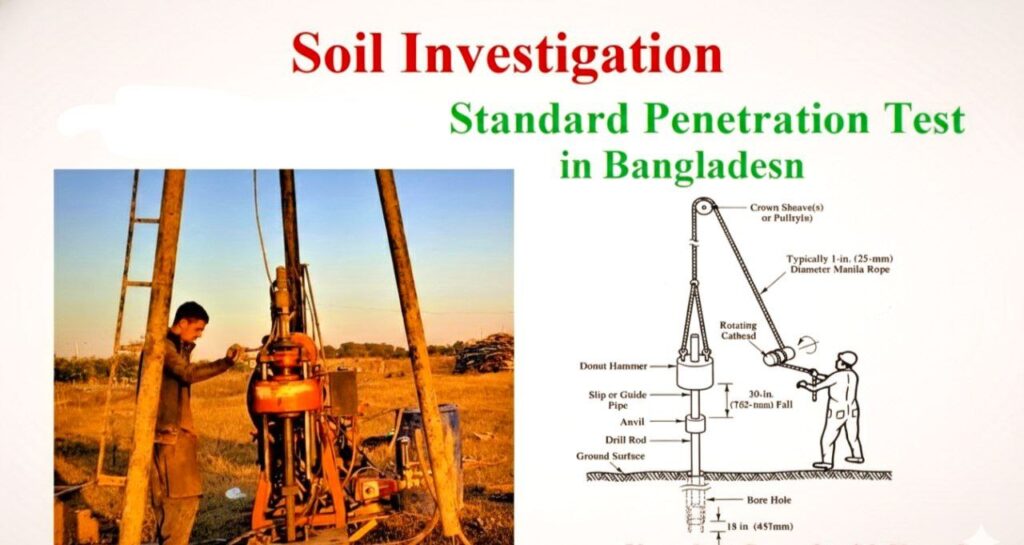
SPT (Standard Penetration Test) is the most widely used in-situ soil testing method globally. It measures soil resistance by counting how many hammer blows are needed to drive a standard sampler 30cm into the ground.
The SPT-N value indicates:
- 0-4: Very loose/soft soil (unsafe for foundations)
- 4-10: Loose/soft soil (requires ground improvement)
- 10-30: Medium dense soil (suitable for shallow foundations)
- 30-50: Dense soil (good bearing capacity)
- >50: Very dense soil or rock (excellent for any foundation type)
SPT is reliable, cost-effective, and provides both soil samples and strength data. This is why it remains the industry standard in Bangladesh.
6. Can I use an old soil test report for my new building?
No. Soil conditions can change due to:
- Changes in groundwater table
- Nearby construction activities
- Fill placement or excavation
- Seasonal variations
More importantly, each building has different loading conditions. A 5-year-old soil test done for a 4-story building cannot be used for a new 8-story design.
I recommend new soil testing for every project. If your plot had testing within the last 2 years and the building configuration is similar, discuss with your geotechnical engineer — in some cases, supplementary testing may be acceptable instead of complete re-investigation.
7. What happens if I skip the soil test to save money?
I’ve documented three scenarios from my own projects:
Case 1 — Differential Settlement (Mohammadpur, 2018): A 6-story building constructed without proper soil testing developed 4-inch differential settlement within 18 months. Repair cost: ৳18 lakhs. Original soil test would have cost: ৳35,000.
Case 2 — Foundation Failure (Uttara, 2020): Shallow foundation designed based on assumed bearing capacity failed during construction. Had to redesign with pile foundation mid-construction. Additional cost and delay: ৳45 lakhs + 6 months.
Case 3 — RAJUK Rejection (Bashundhara, 2021): Building plan rejected due to missing geotechnical report. After obtaining proper soil test, foundation design had to be completely revised. Cost of redesign + time loss: ৳12 lakhs + 4 months delay.
In all three cases, the building owners tried to save ৳25,000-৳40,000 on soil testing and ended up spending 40-100 times more fixing the consequences.
8. Does soil test cost vary by season in Bangladesh?
Technically, soil testing can be done year-round. However:
Dry season (November-March): Ideal conditions, faster field work, standard rates
Monsoon season (June-September): Field work more challenging due to flooding and water-logged conditions. Some companies charge 10-15% premium for monsoon work. Drilling in water-logged sites requires additional dewatering efforts.
I recommend scheduling soil tests during dry season when possible, especially for sites in low-lying areas prone to flooding.
9. What is the difference between soil test for building vs. agricultural soil test?
Completely different purposes and methods:
Building/Construction Soil Test (Geotechnical Investigation):
- Measures: Bearing capacity, shear strength, settlement characteristics
- Methods: SPT boring, laboratory mechanical tests
- Cost: ৳25,000-৳3,00,000+
- Purpose: Foundation design and structural safety
Agricultural Soil Test:
- Measures: pH, NPK (nitrogen-phosphorus-potassium), organic content
- Methods: Chemical analysis
- Cost: ৳500-৳3,000 per sample
- Purpose: Crop productivity and fertilizer recommendations
Never confuse the two. An agricultural soil test kit cannot tell you anything about bearing capacity for construction.
10. Can soil test cost be reduced by testing fewer points or less depth?
Technically yes, but this is extremely risky and violates BNBC guidelines.
The minimum requirements exist for good engineering reasons:
- 3 boreholes minimum ensures you capture soil variability across the site
- Depth requirements ensure you test soil below your foundation influence zone
Cutting corners on soil testing is like conducting surgery with half the necessary medical tests. The short-term saving leads to long-term catastrophe.
If budget is a genuine constraint, discuss with your geotechnical engineer. We can sometimes optimize borehole locations or depths based on site-specific conditions, but we cannot go below minimum safety standards.
Summary: Making the Right Decision on Soil Test Cost in Bangladesh
After 17 years of geotechnical engineering practice across Bangladesh, I can state this unequivocally: Soil testing is not an expense — it is the most critical investment in your building’s safety and longevity.
Key Takeaways:
✓ Expect to pay ৳25,000-৳35,000 for a basic residential soil test (3 points, 60 feet, standard lab tests) in Dhaka
✓ Commercial and high-rise projects require comprehensive testing: ৳60,000-৳3,00,000 depending on complexity
✓ Location, depth, and number of boreholes are the primary cost drivers
✓ BNBC-2020 mandates minimum 3 boreholes — this is non-negotiable
✓ Choose certified companies with registered geotechnical engineers, even if they cost 20-30% more
✓ Hidden costs exist — budget an additional 15-20% for site preparation and potential supplementary testing
✓ Return on investment is massive — proper soil testing typically saves 20-50 times its cost by preventing foundation problems
The foundation is the one part of your building you cannot retrofit easily. Once construction begins, correcting foundation mistakes costs exponentially more than doing it right the first time.
At GeoBuilderBD, we’ve conducted soil investigations for residential homes, commercial towers, industrial facilities, and infrastructure projects across Bangladesh. Our commitment is simple: transparent pricing, BNBC-compliant methodology, certified laboratory testing, and reports you can stake your building’s safety on.
Your building deserves a foundation built on data, not guesswork.
Contact GeoBuilderBD today for a detailed quotation based on your specific project requirements. We’ll conduct a site visit, assess your testing needs according to BNBC-2020 guidelines, and provide you with a clear, itemized proposal with zero hidden charges.
Because when it comes to soil testing in Bangladesh, the right choice isn’t the cheapest option — it’s the one that ensures your building stands strong for generations.
Need a Soil Test for Your Project?
📞 Contact GeoBuilder
🌐 www.geobuilderbd.com
📧 Expert consultation, transparent pricing, BNBC-compliant testing
Professional geotechnical investigation services across Dhaka, Chittagong, Sylhet, and all districts of Bangladesh.